Websites for
Websites for accountants and professional firms
Most of your clients arrive by referral, and nearly all of them check your site before they call. The site's job is to survive that second look: prove the firm is real, answer the money question honestly, and make the first contact easy.
The referral check
Accountants rarely need to be discovered. They need to not lose the referral between the recommendation and the phone call. The client Googles your name, and whatever they find in the next thirty seconds either confirms the referral or quietly kills it.
What confirms it is unglamorous: a real photo of real people, credentials stated plainly, a physical address, services written so a client recognizes their own situation, and a site that was clearly touched this decade. What kills it is a template from 2014 with a stock photo of a calculator.
Services a client can scan
Personal tax, business tax, bookkeeping, payroll, advisory: each of these is a different client with a different problem, and each gets its own page. Partly because that is how a scanning reader finds their situation, and partly because each one is a different search Google can send to you.
The page structure follows the client's questions, not your org chart: what it covers, who it is for, what it costs or how pricing works, and what to do next.
The fee question
Every prospective client wants to know what it costs, and most firm sites make them call to find out. An honest structure works better: starting-at prices for the defined services, and a clear explanation of what moves a quote for the rest. It filters out the shoebox-of-receipts clients you did not want and reassures the ones you did.
This is one of the places a well-run site pays for itself quietly. Better-matched inquiries mean fewer first meetings that were never going to close.
Intake that asks for the right amount
A firm website's contact form should collect the minimum: name, contact, what they need, individual or business. Not documents, not Social Security numbers, not tax details. Anything sensitive belongs in your client portal, and the site links to SafeSend, ShareFile, or whatever you already use rather than imitating it.
That restraint is a feature you can say out loud on the site. Telling clients you do not take sensitive data through a web form is a trust signal most firms never think to use.
What this looks like built
Wahl Appraisal Service is a real professional-services client: a residential appraiser whose site I organized around the reason someone needs an appraisal rather than the word itself. Inbound leads are up about 55 percent since launch, client-reported, and I still host and maintain the site.
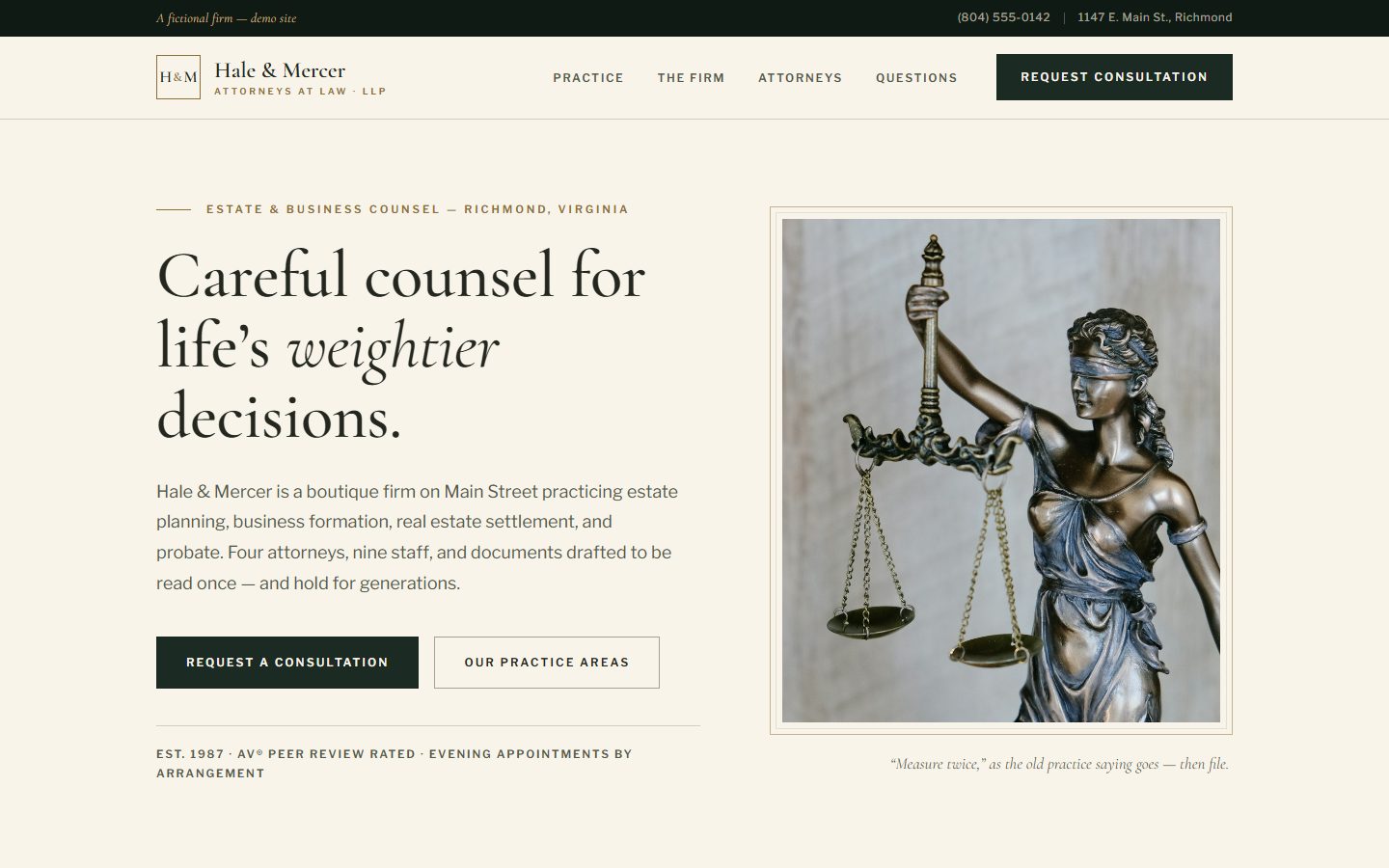
For the design register, the Hale and Mercer demo is a concept build for a boutique law firm: ledger rules, restrained type, and a consultation form that validates properly. Different profession, same problem. The site has to look like the invoice justifies itself.
Cost and timing
Professional firm sites start at $1,000 and typically launch in one to two weeks: the services structure, team or bio pages, the fee framework, and the intake. The quote is fixed after we talk.
One timing note specific to this trade: builds run smoothest outside tax season. If you are reading this in January, a free audit still works, and we schedule the build for when you can actually look at drafts.
Proof
A real appraisal firm I built and still maintain, inbound leads up about 55 percent since launch per the client, plus a concept build for a boutique law firm showing the register a professional site needs.

Questions
Can clients request a consultation through the site?
Yes. The intake form collects the minimum, name, contact, what they need, individual or business, and lands with whoever books consultations. Sensitive material stays out of the form entirely; your client portal handles document exchange, and the site links to it.
Should the website list fees?
An honest structure beats a price list or a wall of silence: starting-at numbers for the defined services like returns and cleanups, and a clear explanation of what moves a quote for everything else. It filters out bad-fit inquiries and reassures the clients you actually want.
Can you build us a client portal?
No, and you would not want me to. Document exchange and e-signatures belong in your existing portal, SafeSend, ShareFile, TaxDome, whatever you use, where the security and compliance live. The site links to it cleanly. What I build is everything the public sees before the portal.
We are on an accountant-website platform. Can you move us?
Yes. The content migrates, the domain comes with you, and redirects keep whatever search presence you have. Most firms end up with a faster, cheaper site that looks like a practice instead of a platform template.
Talk to me
Ready when you are. Start a project.