Websites for
Websites for contractors and home services
A contractor's website has one job: make the phone ring or the quote form fill up. I build fast, phone-first sites with your real work front and center, your service area spelled out, and a way to request a quote on every page.
What a contractor site actually needs
Four things, in order of importance. A phone number that's tappable and visible on every page, because most of your visitors are on a phone held in one hand. A quote request form short enough to fill out in a driveway: name, contact, what the job is, where it is. Photos of your real work, because homeowners can smell stock photography and it costs you the call. And your license and insurance details where people can actually find them.
Everything else is secondary. Reviews help, a clean services list helps, and load time helps most of all: a homeowner comparing three contractors calls the one whose site loaded first.
Service areas and the map pack
Trade searches are almost all local. Homeowners search "plumber in Fairfax" or "concrete contractor near me," and Google answers with the map pack first. Your site and your Google Business Profile have to tell the same story: same name, same phone, same towns. I set up or clean up the profile as part of the build.
On the site itself, the service area is written out in language Google understands, and each trade you offer gets its own page. If you genuinely serve several towns, the site says so honestly. What I don't do is generate fifty doorway pages for towns you've never worked in; that trick gets sites filtered out, not found.
What this looks like finished
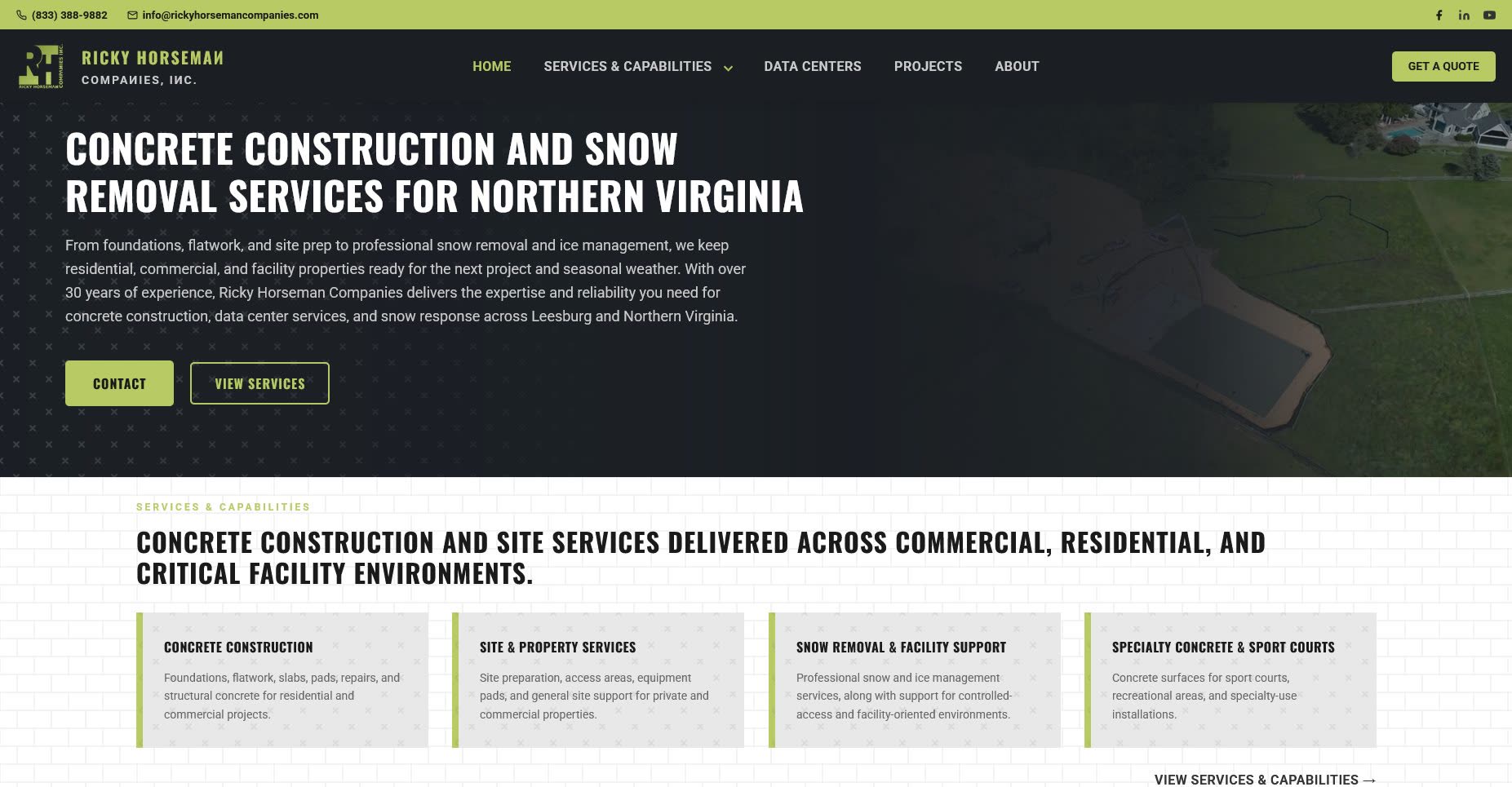
I designed and built the site for Ricky Horseman Companies, a Leesburg concrete and site-services contractor working since 1991. It runs four service lines, a quote request flow on every page, a real project portfolio, and Angi and Yelp reviews labeled by the job they were for. The full case study is public.
That's the same structure I'd build for you: proof of work, an obvious next step, and the service area spelled out, whether you pour concrete, wire panels, or remodel kitchens.
Cost and timing
Most contractor and home service sites start at $1,000 and launch in one to two weeks. That covers the design, the build, your service pages, the quote form, and the local search setup. Hosting, updates, and backups after launch run $25 to $150 a month depending on how hands-off you want to be.
You get a fixed quote after we talk. No hourly billing, and no surprise invoice when you ask for one more job photo swapped in.
Proof
A Leesburg concrete contractor I designed, built, and still maintain, plus a concept build showing how I'd handle a B2B components manufacturer.

Questions
Do leads come through the quote form or the phone?
Both, and the site is built for both. A tappable number sits in the header on every page for people who call, and the quote form catches everyone else, especially after hours. Submissions land in your email with the job details attached, so you can call back already knowing what the work is.
Can I add photos of jobs myself?
Yes. WordPress builds come with a simple gallery field; on hand-coded sites I handle swaps as part of your care plan. Either way, job photos are the highest-value content on a contractor site, so adding them is always easy and you get a short walkthrough at handover.
Should I have a page for every town I serve?
Only the ones you actually serve. Real service-area pages for real towns help you rank; a stack of auto-generated doorway pages for places you've never worked gets sites filtered out of Google. I build the honest version: your real coverage area, written out properly.
I'm on Angi and HomeAdvisor. Do I still need a site?
Yes. Those platforms own the lead and sell it to you and your competitors at the same time. Your own site is the only channel where the lead is exclusively yours, and it's the first thing people check after finding you anywhere else.
Talk to me
Ready when you are. Start a project.