Websites for
Websites for salons and spas
A salon or spa site sells trust before it sells a time slot: does the room look like somewhere you want to be, does the work look like results you would want, and can you book in under a minute. I build sites that answer all three and hand the appointment to whatever booking platform you already use.
The site has to look like the room
In this trade the website's design is a credential. A brow studio with a site that looks like a spreadsheet loses clients to a competitor whose site looks like her work. The typography, the palette, and the photography have to feel like the experience of sitting in your chair, because that is what the client is buying.
That does not mean heavy. An elegant site can still load in a second on a phone over salon wifi, and it should, because that is where most of your clients will open it.
What the Blushline demo shows
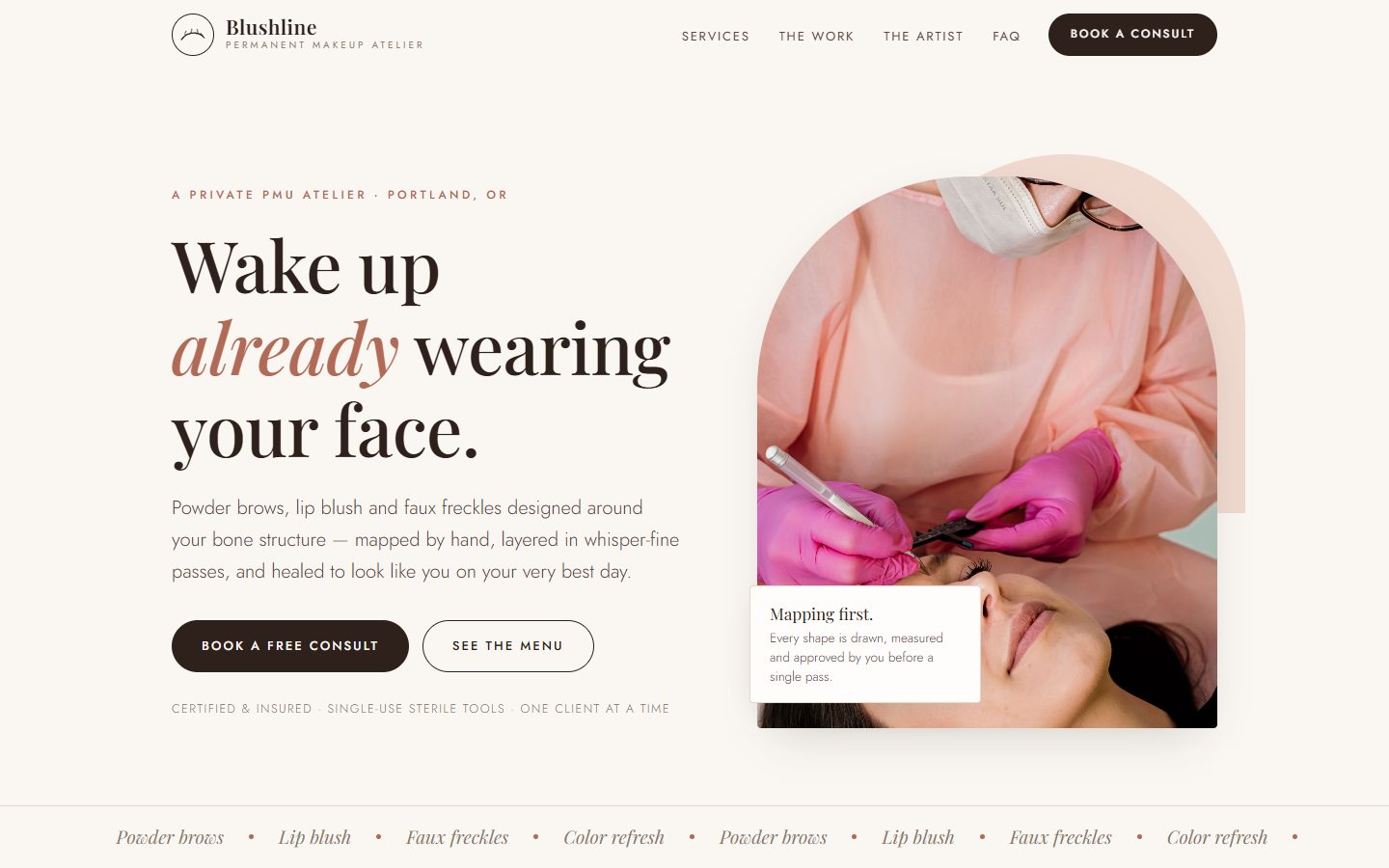
The Blushline Studio demo is a concept build for a private permanent-makeup atelier: porcelain-and-blush editorial design, a service menu with real prices, a healed-results gallery, and a booking flow that preselects whichever service the client clicked. The case study explains the thinking.
Blushline is a concept, not a real studio, and I am upfront about that. What it proves is the register: a beauty or wellness site should read like the appointment feels, and the booking path should be one tap past the service that convinced them.
Keep your booking platform
If you run your books on Vagaro, Fresha, Booksy, Square Appointments, or GlossGenius, keep it. The platform is good at taking appointments and bad at being your website. I build the site around it: your services, your prices, your brand, with the booking buttons and links pointed at the platform where the appointment actually lands.
The useful detail is the deep link. Each service on the site can point at that service's booking screen, so a client who just read about brow lamination books brow lamination instead of hunting through your whole menu.
The menu question
Publish the prices. A service menu without numbers reads as either expensive or disorganized, and the client who cannot find your prices finds a competitor's instead. Each service gets a name a client would recognize, a real price or a starting-at, the duration, and one honest sentence about what it involves.
The menu also does search work. Balayage, lash lift, deep-tissue massage: each service name is a term someone near you is Googling, and a site with a proper menu gives those searches somewhere to land.
The gallery, handled carefully
Before-and-after and healed-results photos sell this work better than any copy, and they need handling: client consent first, honest captions, and no filters making the result look like something it was not. For services like permanent makeup and injectables, healed photos matter more than fresh ones, and the site can say so.
Staff bios earn their place too. A face, a specialty, and one sentence of personality per person gives the client someone to ask for by name.
Gift cards and the retail shelf
Gift cards are the easiest money a salon site can make, especially in November and December. Most booking platforms already sell them, so the site needs a visible link more than it needs a feature.
A product shelf is different. If clients regularly buy the retail you stock, a small Shopify store can pay for itself. If they do not, a page listing what you carry is enough, and I will tell you which side you are on.
Cost and timing
Salon and spa sites start at $1,000 and typically launch in one to two weeks: design, service menu, gallery, bios, booking integration, and the local search setup. A shop adds scope, and the quote is fixed before work starts.
If your current site might be worth keeping, send me the URL for a free audit and I will tell you what I would fix first.
Proof
A concept build for a permanent-makeup atelier: priced service menu, healed-results gallery, and a booking flow that preselects the service. Open the demo and the register of the design speaks for itself.
Questions
We book through Vagaro, Fresha, or Booksy. Does that stay?
Yes. Your booking platform keeps taking appointments exactly as it does now. The site wraps your brand, services, and search presence around it, and each service links to that service's booking screen so clients land in the right place.
Should our prices be on the website?
Yes. A menu without prices reads as expensive or disorganized, and the client who cannot find your numbers finds a competitor's. Starting-at prices are fine where the work varies, as long as the number is honest.
Can we show before-and-after or healed results?
Yes, and they should be prominent since they sell this work better than any copy. I will set the gallery up with consent and honest captioning in mind, and for services like permanent makeup the healed photos get top billing over fresh ones.
Can clients buy gift cards or products online?
Gift cards are easy: most booking platforms already sell them, so the site links out visibly. For retail, a small Shopify shop makes sense when clients actually buy your product line; otherwise a what-we-stock page is the honest amount of machinery.
Talk to me
Ready when you are. Start a project.