Websites for
Websites for weddings and events
The wedding website is the piece of stationery your guests actually use: the schedule, the hotel block, the registry, and the RSVP all live at one address. I build custom wedding and event sites that look like your invitations, work like a form designed by someone who has filled one out, and stay yours after the day is over.
The reply card is the whole point
Everything on a wedding site is decoration next to the RSVP. The form I build collects what a real reply card collects: each guest's name, whether they are coming, meal choices where the caterer needs them, plus-ones where you have offered them, dietary notes, and a line for anything else. Answers land in your inbox or a spreadsheet, sorted by household, and you set the deadline it stops accepting replies.
Guests do not need an account, an app, or a confirmation code. They open the link from your invitation, tap their names, answer three questions, and get a confirmation. The Rowan and Cassia demo shows the register I aim for: the RSVP is drawn as an actual reply card, joyfully accepts and regretfully declines, because the site should feel like the invitation suite it replaced.
Zola and The Knot are free for a reason
The free wedding platforms are not in the website business. They are in the registry and vendor business, and your site is the funnel that feeds it. Your guests get steered toward partner registries, your template looks like every other couple's, your photos sit on a subdomain you do not own, and when the wedding is over the whole thing belongs to them.
A custom site is the opposite trade. It costs money once, does exactly what you need and nothing you do not, lives on your own domain, and links to whatever registries you actually chose. If the comparison shopping brought you here, that is the honest answer to wedding website vs Zola or The Knot: you are paying for ownership and a design that is yours.
Privacy sized to a guest list
Wedding sites get shared by link, so the default build keeps them out of search results: an unlisted URL and a noindex flag mean only people with the address can find it. If the guest list needs more, I can put the whole site behind a shared password, printed on the invitation.
There is no public comment wall and no guest book open to the internet unless you ask for one. The only people who see the schedule, the hotels, and the registry are the people holding an invitation.
What the site carries
The standard build covers the weekend schedule, ceremony and reception details, travel and hotel blocks, dress code, your story and photos, registry links, and a guest FAQ for the questions that would otherwise become forty text messages. A countdown to the date is optional. Everything is phone-first, because most guests open the site on the phone in their hand at the airport.
If your wedding is smaller, the site can be too. A single elegant page with the date, the place, the hotels, and the RSVP is a legitimate build and it costs less. We scale it to the event, not to a package.
Timing against the invitations
The site URL usually goes on the save-the-dates or the invitations, which sets the real deadline: the site needs to be live before the mail goes out. Starting two to four months before that date is comfortable. Most builds take one to two weeks once I have your details, and faster is possible if the envelope is already stamped.
What I need from you is short: the date and venues, the hotel block codes, the registry links, photos you want to use, and the RSVP questions your caterer cares about. If some of that is not settled yet, we build around the placeholders and swap them in when they are.
After the wedding
Couples usually pick one of three endings. Keep the site live as a keepsake with the RSVP swapped for a thank-you note and a photo gallery. Let it run quietly until the domain lapses. Or take it down entirely and keep the files. Any of the three works, because you own the domain and the code either way.
The most common choice is the keepsake version: a one-time update after the honeymoon, then the site sits as a time capsule. Whatever you pick, there is no subscription from me keeping it alive.
Events beyond weddings
The same mechanics cover the other events people actually organize: milestone anniversaries, family reunions, a 40th birthday that got out of hand, fundraisers and galas, memorials and celebrations of life. If it has a guest list and a date, it can have a site with an RSVP that works.
For the corporate version of this, launch parties and client events, the build is the same with the register turned more professional. The reply mechanics do not change.
What it costs
A single-page wedding micro-site starts around $500. A fuller weekend site with the schedule, travel, gallery, and RSVP starts around $1,000. You get a fixed quote after a short conversation, and I can usually tell you which of the two your plans actually need within the first ten minutes.
If you want to see the shape first, open the Rowan and Cassia demo or read the case study behind it. Try the reply card on your phone; that is exactly the flow your guests would get.
Proof
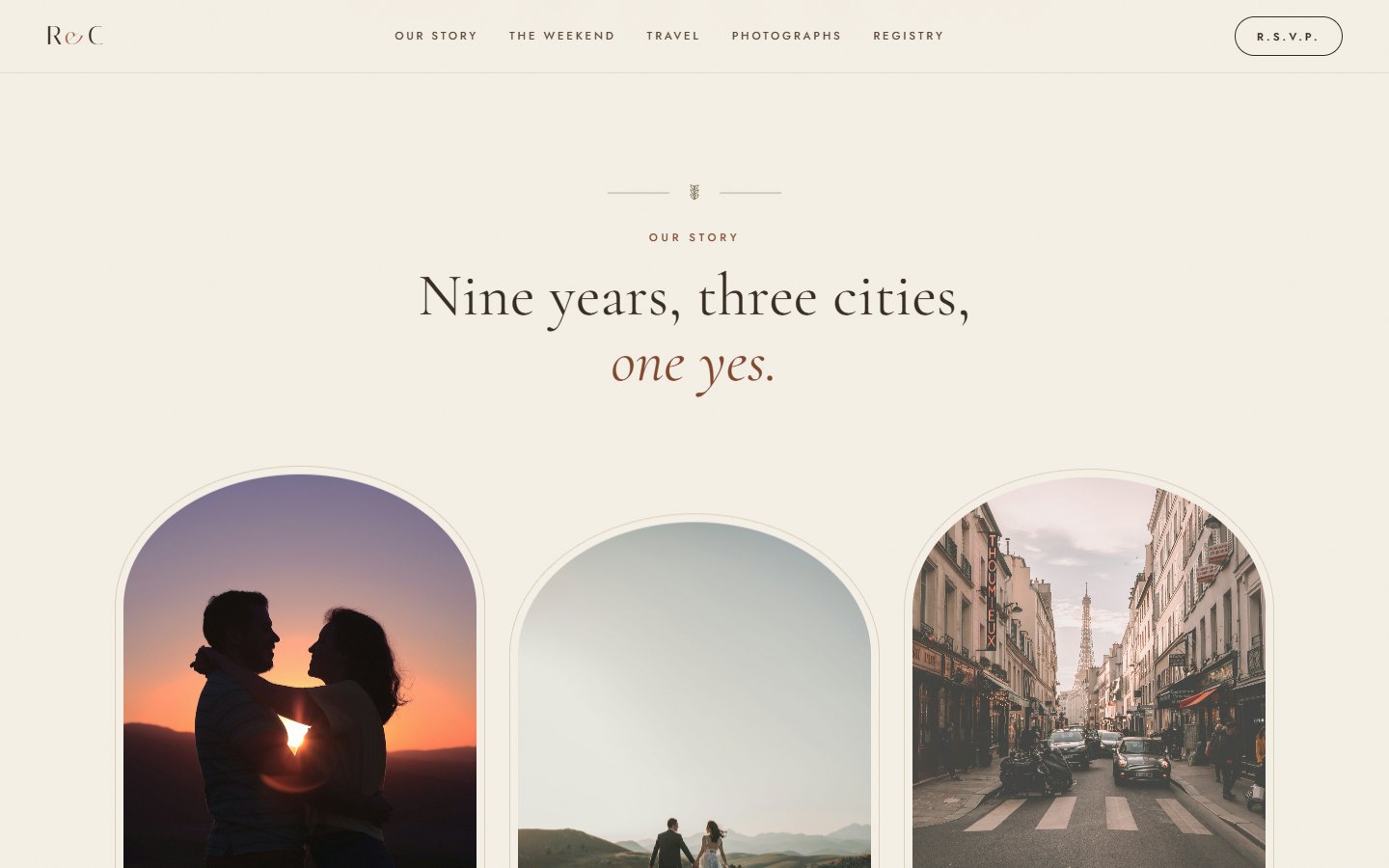
A concept build for a wedding micro-site: fine-art invitation typography, a live countdown, weekend schedule and travel details, and an RSVP designed as a reply card. Open the demo and try the reply flow on your phone.
Questions
Can guests RSVP directly on the website?
Yes, and it is the feature the whole site is built around. The form collects names, attendance, meal choices, plus-ones where you have offered them, dietary notes, and a message. Replies come to your email or a spreadsheet grouped by household, guests need no account, and the form stops accepting replies on the deadline you set.
Why not just use Zola or The Knot?
Those platforms are free because your guest list is the product: the site steers guests toward partner registries and vendors, and the template is the same one everyone else gets. A custom site costs money once and gives you your own domain, a design that matches your invitations, and files you keep. You can still link to any registry you like.
Can the site stay private?
That is the default. The site ships unlisted and flagged to stay out of search engines, so only people holding the URL find it. A shared password is an easy addition if your guest list needs it.
When should we start?
Two to four months before your invitations or save-the-dates mail is comfortable, because the URL goes on them. The build itself takes one to two weeks once I have your details, and I can work around details that are not final yet.
What happens to the site after the wedding?
Your call. Most couples keep it live as a keepsake with the RSVP swapped for a thank-you and a photo gallery, some let it run quietly, and some take it down. You own the domain and the files in all three cases, and there is no ongoing fee from me.
Do you build sites for events other than weddings?
Yes. Anniversaries, reunions, galas, memorials, launch parties: anything with a guest list and a date gets the same treatment, with the tone adjusted to the event.
Talk to me
Ready when you are. Start a project.